- Market Value (2025): USD 6.2 Bn
- Estimated Value (2026): USD 6.52 Bn
- Forecast Value (2036): USD 10.8 Bn
- CAGR (2026-2036): 5.2%
Radiant Burners Market Forecast and Outlook 2026 to 2036
The global radiant burners market stood at USD 6.2 billion in 2025 and reached USD 6.52 billion in 2026. The market is set to reach USD 10.8 billion by 2036, expanding at a CAGR of 5.2% during the 2026 to 2036 assessment period.
Radiant burners are gaining relevance in industrial heating as manufacturers seek better control over heat distribution and fuel consumption. Metal fiber and ceramic burner designs are attracting attention because they support different temperature requirements and can be engineered for different gaseous fuels. Metal fiber combustion technology is also relevant to premix heating applications, including condensing boilers. Industrial operators are examining burner configurations that improve thermal efficiency and control emissions. The transition towards cleaner combustion and more efficient heating processes is creating additional opportunities for radiant burner manufacturers through 2036.
Key Takeaways from the Radiant Burners Market
- Sales of radiant burners stood at USD 6.2 billion in 2025.
- Radiant Burners Market Value (2026): USD 6.52 billion.
- Radiant Burners Market Forecast Value (2036): USD 10.8 billion.
- Radiant Burners Market Forecast CAGR (2026 to 2036): 5.2%.
- Leading Product Type: Infrared Radiant Burners (42.3%).
- Key Market Participants: Honeywell International Inc., Fives Group, Selas Heat Technology Company, ESA Pyronics, ALZETA Corporation and Bloom Engineering.
- Key Growth Regions: Germany, Brazil, United States, United Kingdom and Japan.
Germany's building modernisation legislation underwent a significant change in July 2026. The new legislation replaced the previous Building Energy Act framework and removed the uniform 65% renewable energy requirement for heating systems. It allows greater flexibility in heating technology selection while introducing measures for the gradual use of climate-neutral fuels. These regulatory changes influence equipment selection and fuel compatibility considerations across the heating industry. Industrial burner manufacturers are also examining hydrogen-compatible combustion systems for applications where complete electrification presents operational challenges. Such developments are creating opportunities for specialised radiant burner technologies.
Radiant Burners Market
| Metric | Value |
|---|---|
| Estimated Value in 2025 | USD 6.2 billion |
| Estimated Value in 2026 | USD 6.52 billion |
| Forecast Value in 2036 | USD 10.8 billion |
| Forecast CAGR (2026 to 2036) | 5.2% |
Source: Fact.MR analysis. Updated Nov 20, 2026
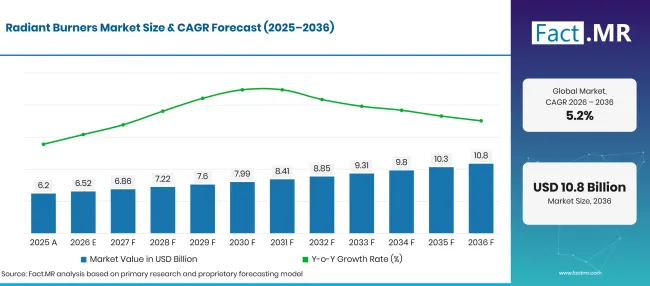
Radiant Burners Market Forecast Global | Source: Fact.MR
Category
| Category | Segments |
|---|---|
| Product Type | Infrared Radiant Burners, Ceramic Radiant Burners, Metal Fiber Radiant Burners |
| Application | Commercial Heating, Industrial Heating, Residential Heating |
| Fuel Type | Natural Gas, Propane, Electric, Others |
| End-User | Food Processing, Chemical Industry, Automotive, Textile, Others |
| Region | Germany, Brazil, United States, United Kingdom, Japan |
Source: Fact.MR analysis. Updated Nov 20, 2026
Segmental Analysis
Why do infrared radiant burners lead product demand in the Radiant Burners Market?
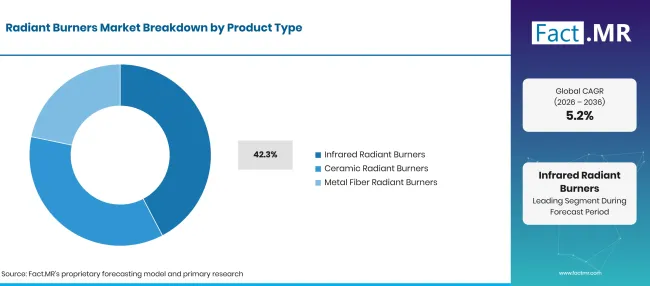
Radiant Burners Market Breakdown Product Type | Source: Fact.MR
Infrared radiant burners hold a 42.3% revenue share in 2026, equivalent to approximately USD 2.76 billion. Their ability to transfer heat directly to surfaces, materials and occupied areas makes them useful in industrial drying, manufacturing and large-space heating. Ceramic and metal fiber emitters also address different temperature requirements across industrial processes. The Illinois Statewide Technical Reference Manual, Version 14.0, effective January 2026, includes technical guidance for energy efficiency measures across different building and equipment applications. The broad applicability of infrared heating in industrial and commercial environments reinforces the position of infrared designs in the market.
Why does commercial heating lead application demand in the Radiant Burners Market?
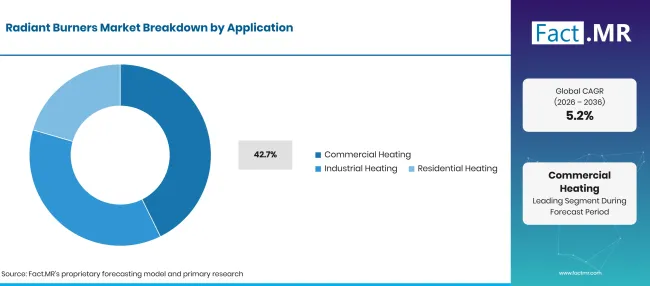
Radiant Burners Market Breakdown Application | Source: Fact.MR
Commercial heating contributes 42.7% of market revenue in 2026, reaching approximately USD 2.78 billion. Warehouses, workshops, sports facilities and retail buildings often have high ceilings, making conventional air heating less effective for maintaining comfortable temperatures in specific occupied areas. Radiant systems address this limitation by directing warmth towards selected zones rather than heating the entire air volume. NITI Aayog estimated commercial building electricity demand in India at approximately 137 TWh in 2025. This indicates the considerable energy requirements of commercial buildings and the importance of improving heating and cooling efficiency.
Why does natural gas lead fuel demand in the Radiant Burners Market?
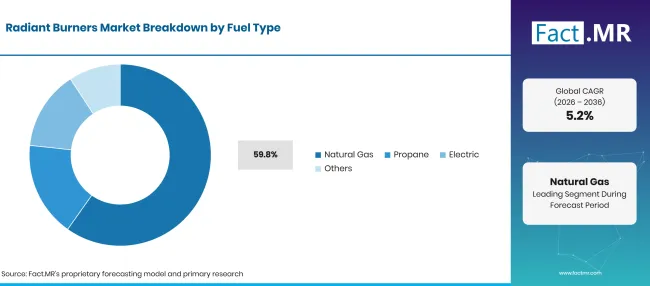
Radiant Burners Market Breakdown Fuel Type | Source: Fact.MR
Natural gas accounts for 59.8% of market revenue in 2026, equivalent to approximately USD 3.90 billion. Existing pipeline connections, established combustion infrastructure and controllable heat output make it a practical fuel for commercial heating and industrial operations. Propane serves facilities without direct pipeline access, while hydrogen blends are entering burner technology research and testing programmes. According to the U.S. Energy Information Administration, natural gas consumption in the United States averaged a record 92.0 billion cubic feet per day in 2025. Continued use of natural gas across major end-use sectors reinforces its position as the leading fuel category.
Why does food processing lead end-user demand in the Radiant Burners Market?
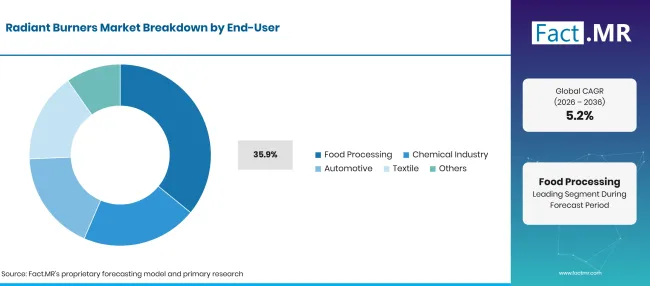
Radiant Burners Market Breakdown End User | Source: Fact.MR
Food processing represents 35.9% of market revenue in 2026, amounting to approximately USD 2.34 billion. Bakery ovens, roasting lines and continuous drying equipment use radiant heat to achieve consistent surface temperatures across production operations. Food manufacturers also examine burner technologies that allow precise temperature regulation and better control over heat losses. India's Ministry of Food Processing Industries reported in January 2026 that processed food exports accounted for 20.4% of the country's agri-food exports in 2024-25. This indicates the importance of the food processing industry within India's manufacturing and export base.
Radiant Burners Market: Drivers, Restraints and Trends
Driver: Rising Need for Targeted Heating in Large Industrial Spaces:
Factories, distribution centres and logistics facilities often face challenges in maintaining uniform temperatures across large floor areas. Radiant heating addresses this issue by transferring warmth directly to workers, equipment and surfaces instead of heating the entire air volume. This makes zone-based temperature control more practical in high-ceiling buildings and helps limit unnecessary heat losses. As industrial operators pay closer attention to heating expenses and workplace comfort, investment in radiant heating installations is gaining commercial relevance.
Restraint: Shift Towards Electrified Heating Systems:
Gas-fired radiant burners face pressure from policies encouraging electric heating and lower-carbon building operations. The European Commission presented its Electrification Action Plan on July 17, 2026, to accelerate the shift towards electricity across industrial and building applications. The EU Social Climate Fund will mobilise at least EUR 86.7 billion between 2026 and 2032, including investment in building renovation and clean heating solutions. However, high equipment replacement costs, electricity price differences and electrical infrastructure upgrades can make the transition difficult for existing facilities.
Trend: Greater Attention to Hydrogen-Compatible Heating:
Hydrogen compatibility is becoming an important consideration as countries examine ways to use existing gas infrastructure with lower-carbon fuels. In July 2025, the UK Department for Energy Security and Net Zero published a study examining hydrogen blends of up to 20% in the National Transmission System. The study assessed potential impacts on equipment performance, safety and operational requirements. This creates opportunities for radiant burner manufacturers working on industrial retrofits, fuel-transition planning and equipment validation. Over time, heating installations that accommodate changing gas compositions could open additional business opportunities.
Trend: Greater Focus on Energy-Efficient In
dustrial Drying:
Manufacturers are examining ways to shorten drying cycles without compromising material quality. A March 2026 research article in Applied Thermal Engineering examined the energy-saving potential of combined infrared and hot-air drying for lithium-ion battery electrodes. The study assessed how coordinated radiation heat flux and inlet air temperature can improve drying efficiency. Such research highlights opportunities for radiant heating technologies in battery manufacturing, coating and other continuous processing operations. Further adoption of controlled thermal processes could widen the use of radiant heating across energy-intensive production lines.
Radiant Burners Market Analysis by Key Country
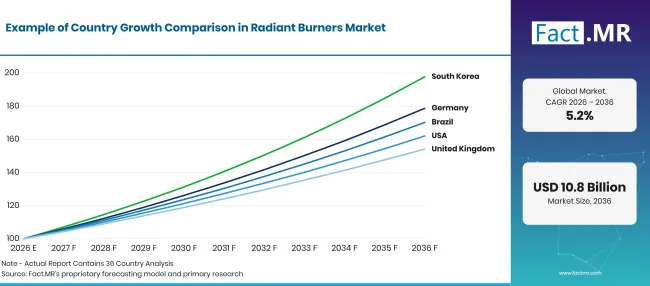
Radiant Burners Market Growth Index | Source: Fact.MR
| Country | CAGR (2026 to 2036) |
|---|---|
| Germany | 6.0% |
| Brazil | 5.5% |
| United States | 4.9% |
| United Kingdom | 4.4% |
| Japan | 3.9% |
Source: Fact.MR analysis. Updated Nov 20, 2026
Why is Germany the fastest-growing market for radiant burners?
Germany's radiant burners market is set to expand at a 6.0% CAGR through 2036, supported by industrial heating upgrades and changes in building energy regulations.
The country's industrial base creates opportunities for specialised combustion equipment across metal processing, manufacturing and thermal treatment. Changes to building modernisation legislation in July 2026 also introduced greater flexibility in heating technology selection while maintaining a focus on lower-emission fuels. These varied industrial and commercial requirements give Germany a stronger growth trajectory than the other countries covered.
What is supporting radiant burner demand in Brazil?
Brazil's radiant burners market is set to grow at a 5.5% CAGR through 2036. Food processing, ceramics production and other heat-intensive industries create opportunities for industrial burner installations.
The country's manufacturing base also increases the need for reliable heating across production facilities. However, uneven access to natural gas infrastructure across industrial regions can influence fuel selection and installation costs. This makes equipment flexibility an important consideration for burner manufacturers operating in Brazil.
What is shaping radiant burner sales in the United States?
The United States market is set to register a 4.9% CAGR through 2036.
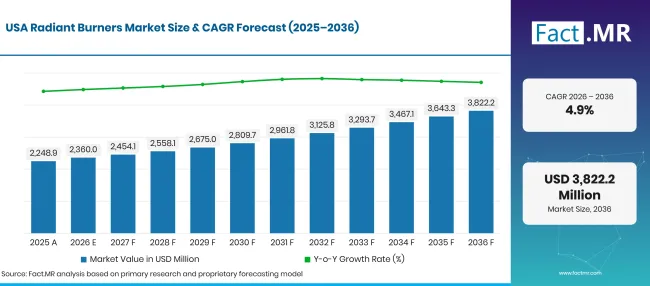
Radiant Burners Market Forecast Usa | Source: Fact.MR
Large warehouses, agricultural buildings, automotive workshops and food processing facilities offer a broad application base for radiant heating. High ceilings and the need to warm specific working areas make infrared systems relevant to commercial and industrial operators. Replacement of ageing heating equipment also creates opportunities for manufacturers offering efficient burner configurations. However, electric heating alternatives may limit gas-fired installations in certain building applications.
What is shaping radiant burner demand in the United Kingdom?
The UK radiant burners market is set to expand at a 4.4% CAGR through 2036.
Industrial facilities and commercial premises offer opportunities for specialised heating equipment, particularly in food manufacturing, workshops and production units. The government's July 2025 hydrogen blending study also highlights the importance of evaluating equipment compatibility with changing fuel compositions. However, investment in heat pumps and other electric heating technologies may restrict the installation of conventional gas-fired systems in some applications.
Why is radiant burner growth slower in Japan?
Japan records the lowest growth rate among the five countries at 3.9%, partly because its heating appliance industry already has a mature customer base.
Residential adoption faces competition from established heat pump and energy-efficient water-heating technologies. Industrial applications, including food manufacturing, ceramics and specialised processing, offer additional opportunities for burner installations. Japanese manufacturers can also pursue overseas industrial markets, although domestic replacement activity may not generate rapid expansion.
Competitive Landscape for Radiant Burners Market
The radiant burners market includes companies with expertise in industrial combustion, furnace heating and specialised burner technologies. Honeywell International Inc. operates through Honeywell Thermal Solutions, which serves industrial heating requirements. Fives Group participates in high-temperature industrial processing through its combustion and heating technologies. Selas Heat Technology Company and Bloom Engineering focus on industrial burner solutions, while ESA Pyronics, ALZETA Corporation, Chugai Ro and Noxmat serve specialised combustion and thermal processing applications.
Competition in this market depends on fuel efficiency, emission control, temperature consistency and equipment life. Manufacturers are also paying greater attention to hydrogen compatibility, lower-NOx combustion and reduced fuel losses. The ability to adapt burner configurations to different industrial processes and fuel requirements will influence competitive positioning through 2036.
Recent Developments
- On February 4, 2026, Honeywell introduced its Hybrid Heating Solution, which combines natural gas and electric heating to help industrial manufacturers reduce energy costs and carbon emissions.
- On May 4, 2026, Fives Group announced a technology partnership with NOC Energy to integrate clean, high-temperature heat technology into its clay calcination pilot plant and explore lower-carbon cement production.
- On April 22, 2026, ESA Pyronics introduced its ALBEN GTC Gas Train Control system as part of its ALBEN digital burner control platform, adding gas train management capabilities to its combustion control portfolio.
- On February 25, 2026, Chugai Ro Co., Ltd. announced the development of its hydrogen FHC-type burner, advancing its work on hydrogen-based industrial combustion technology.
Key Players in Radiant Burners Market
Key companies operating in the market include Honeywell International Inc. (Honeywell Thermal Solutions), Fives Group, Selas Heat Technology Company, ESA Pyronics, ALZETA Corporation, Bloom Engineering, Chugai Ro Co., Ltd., and Noxmat GmbH.
- Honeywell International Inc. (Honeywell Thermal Solutions)
- Fives Group
- Selas Heat Technology Company
- ESA Pyronics
- ALZETA Corporation
- Bloom Engineering
- Chugai Ro Co., Ltd.
- Noxmat GmbH
Bibliography
- Department for Energy Security and Net Zero. (2025, July 23). National Transmission System hydrogen blending: Study. GOV.UK.
- European Commission. (2026, July 17). Electrification.
- European Commission. (2026). Chapter 7: Investments in climate action.
- Government of Germany. (2026). Gebäudemodernisierungsgesetz (GModG). Bundesregierung.
- Ministry of Food Processing Industries. (2026, January 9). Year end review 2025: Achievements and initiatives of Ministry of Food Processing Industries. Press Information Bureau, Government of India.
- NITI Aayog. (2026). Scenarios towards Viksit Bharat and net zero: An overview, Volume 1. Government of India.
- U.S. Energy Information Administration. (2026, March 18). U.S. natural gas consumption set a monthly and yearly record in 2025.
Segmentation
Scope of Report
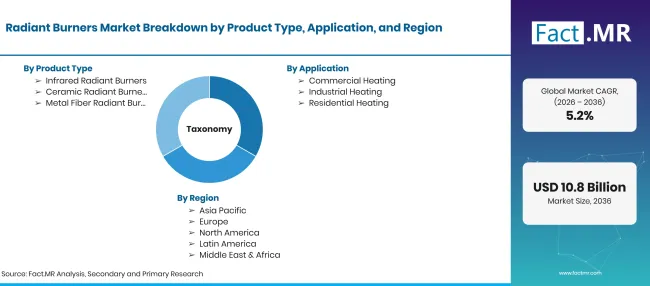
Radiant Burners Market Taxonomy | Source: Fact.MR
| Items | Values |
|---|---|
| Quantitative Units (2026) | USD 6.52 billion |
| Product Type | Infrared Radiant Burners, Ceramic Radiant Burners, Metal Fiber Radiant Burners |
| Application | Commercial Heating, Industrial Heating, Residential Heating |
| Fuel Type | Natural Gas, Propane, Electric, Others |
| End-User | Food Processing, Chemical Industry, Automotive, Textile, Others |
| Regions Covered | North America, Latin America, Europe, East Asia, South Asia and Pacific, Middle East and Africa |
| Countries Covered | United States, Germany, Japan, United Kingdom, Brazil and other countries |
| Key Companies Profiled | Honeywell International Inc., Fives Group, Selas Heat Technology Company, ESA Pyronics, ALZETA Corporation, Bloom Engineering, Chugai Ro Co., Ltd. and Noxmat GmbH |
| Additional Attributes | Dollar revenue in the Radiant Burners Market is segmented by product type (infrared radiant burners, ceramic radiant burners and metal fiber radiant burners); application (commercial heating, industrial heating and residential heating); fuel type (natural gas, propane, electric and others); end-user (food processing, chemical industry, automotive, textile and others) and region. |
Source: Fact.MR analysis. Updated Nov 20, 2026
Radiant Burners Market by Segments
-
Product Type
- Infrared Radiant Burners
- Ceramic Radiant Burners
- Metal Fiber Radiant Burners
-
Application
- Commercial Heating
- Industrial Heating
- Residential Heating
-
Fuel Type
- Natural Gas
- Propane
- Electric
- Others
-
End-User
- Food Processing
- Chemical Industry
- Automotive
- Textile
- Others
-
Region
- North America
- United States
- Canada
- Mexico
- Europe
- Germany
- United Kingdom
- France
- Italy
- Spain
- Rest of Europe
- Asia Pacific
- China
- India
- Japan
- South Korea
- Australia
- Rest of Asia Pacific
- Latin America
- Brazil
- Mexico
- Argentina
- Rest of Latin America
- Middle East and Africa
- GCC Countries
- South Africa
- Rest of Middle East and Africa
- North America
Frequently Asked Questions
How big is the global Radiant Burners Market in 2026?
What will be the size of the Radiant Burners Market by 2036?
How fast will the Radiant Burners Market grow during the forecast period?
Which product type segment holds the largest share of the Radiant Burners Market?
Who worked on this report


Preview the report firsthand - request a free sample
Free SampleGet the brochure for pricing and purchase details
Download PDF